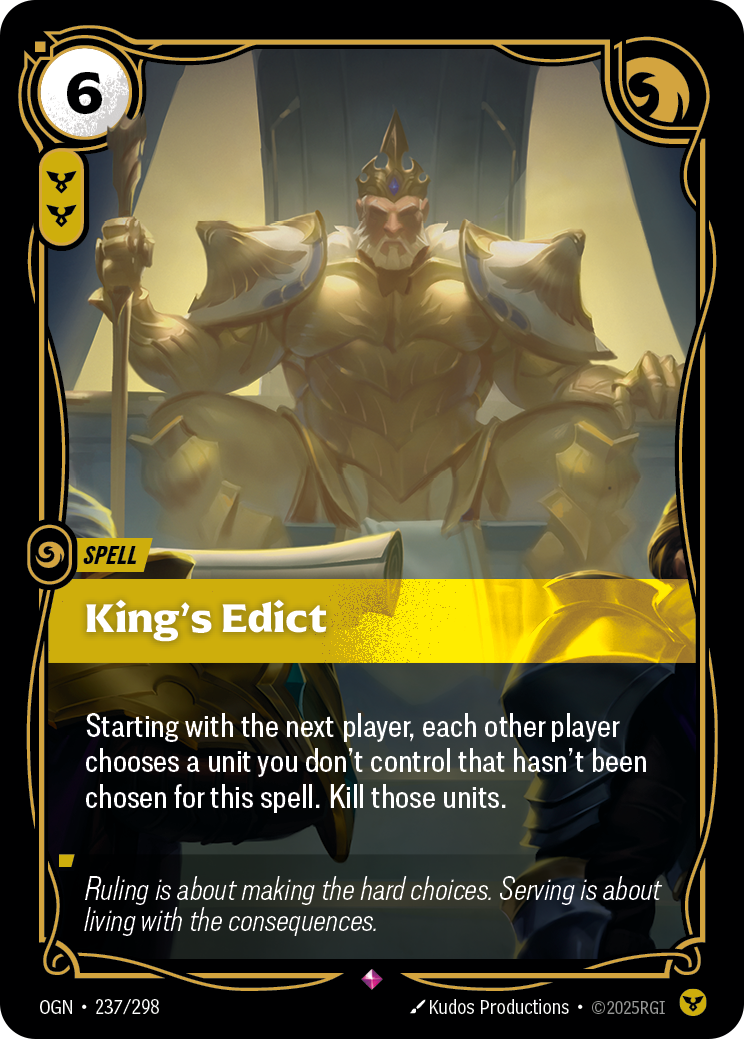
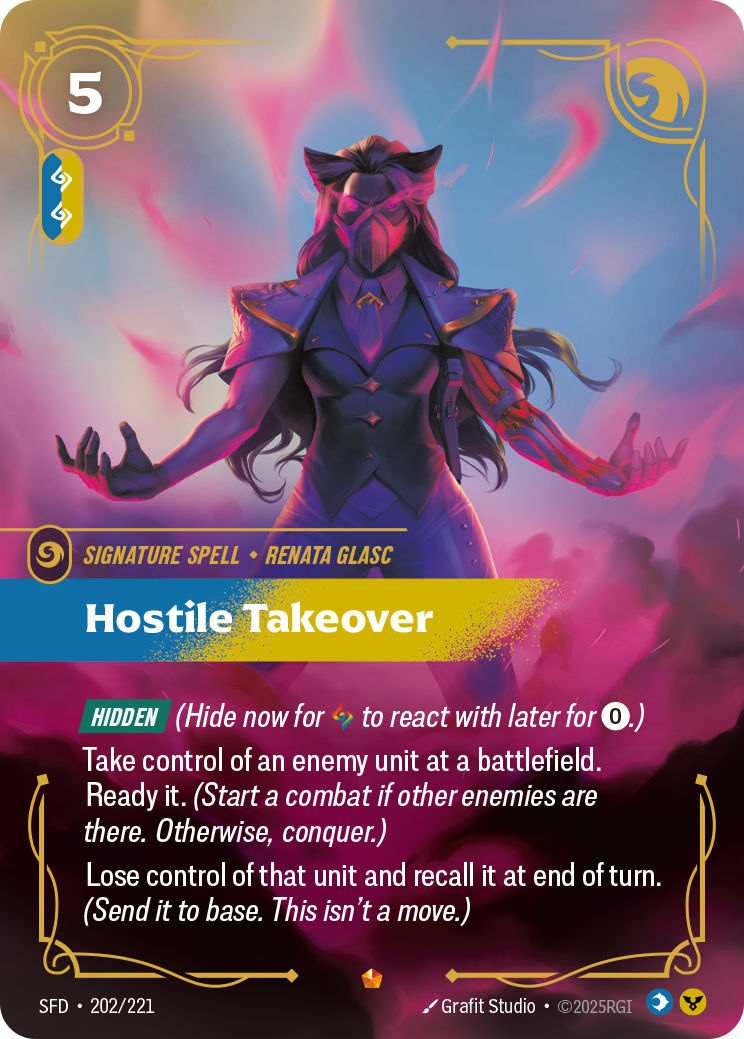
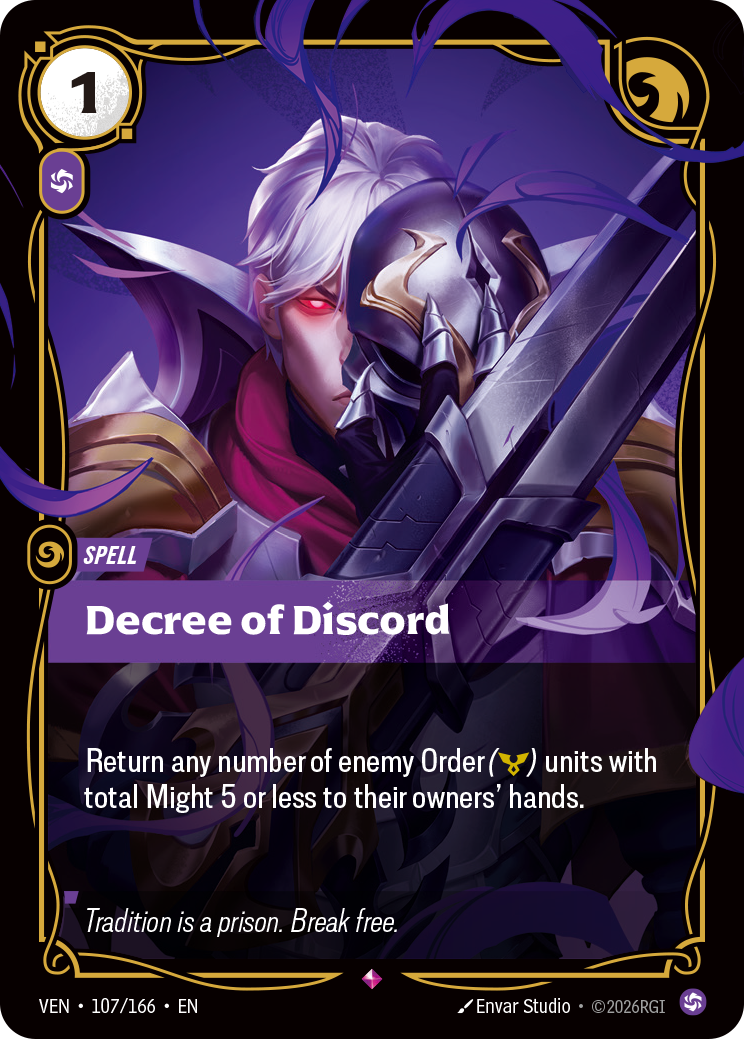
Handling illegal and impossible instructions 1. The spell resolves even if some or all of its targets are illegal. 2. A target is illegal as the spell resolves if it no longer meets the targeting requirements of the spell, or if it has changed Zones to or from a Non-Board Zone. 3. If a target ceases to meet the targeting requirements while the spell is on the chain, then meets them again, it's a legal target. Example: A spell targets "a unit at a battlefield." A player reacts with a spell that moves the unit to base, then another player reacts with a spell that moves it back to that battlefield, then the original spell resolves. The unit is a legal target. 4. If a target changes Zones to or from a Non-Board Zone and then returns to its original zone, it is no longer a legal target, because it's not treated as the same object. Examples: An enemy unit at a battlefield is no longer a legal target if it is no longer an enemy, no longer a unit, or no longer at a battlefield. A unit with 3 or less Might is no longer a legal target if it is no longer a unit or if its Might is greater than 3. Something that's exhausted is no longer a legal target if it is no longer exhausted. (It can't stop being "something.") 5. If any of the spell's targets are no longer legal, those game objects, players, or zones are unaffected by the spell as it resolves. Any instructions related to an illegal target can’t be followed. Example: A player plays Void Seeker, a spell that says "Deal 4 to a unit at a battlefield. Draw 1." The unit's controller uses a Reaction to move the unit to their base. Since the unit is no longer a legal target, it is not dealt any damage. Void Seeker's controller still draws 1. Example: A player plays Bellow’s Breath targeting a unit in combat that reads in part “I can’t be chosen by enemy spells and abilities unless I’m in combat.” In reaction, that unit’s controller plays Flash, moving the unit to their base. The unit is no longer in combat, so it is no longer a legal target for Bellow’s Breath. The unit will be unaffected by Bellow’s Breath as it resolves. Example: A player plays Hidden Blade from the facedown zone at a battlefield, targeting an enemy unit. In reaction to Hidden Blade, their opponent plays Tideturner from facedown at another battlefield, choosing to swap locations with the unit Hidden Blade targeted. When Hidden Blade resolves, the chosen unit is no longer at the appropriate battlefield, so any instructions related to that unit are ignored. 6. Instructions that can't be followed, either because of illegal targets or other circumstances, are ignored. Example: A player plays Ride the Wind choosing to move their unit at Vilemaw’s Lair to base. Base is a legal move destination for Ride the Wind, but on resolution of Ride the Wind’s effect, the move instruction will be ignored because Vilemaw’s restriction makes the instruction impossible. 7. If all of an instruction's Targets become Invalid or Unavailable by the time the spell begins resolving, that instruction will not execute. 8. If an instruction has more than one Target and fewer than all of the Targets become Invalid or Unavailable by the time the spell begins resolving, the instruction will execute, with only the Targets available and valid being operated on. Example: Singularity reads “deal 6 to each of up to two units.” The instruction will execute even if one of those units is made unavailable before the spell begins. 9. The process for a card's choice becoming Invalid or Unavailable is referred to as mistargeting. Example: A spell has the instruction "Deal 2 to a unit at a battlefield." Before that instruction can execute, the chosen unit is moved to its base. The instruction will not be executed, because it specifies that the unit it chooses must be at a Battlefield, and by the time it attempted to execute, the unit was no longer valid as a choice. 9.a. If another spell or ability attempts to reference the number of game objects, players, or zones that a Finalized Chain Item targets, it will include any mistargeted choices, but not any targets that have changed to a non-board zone. Example: When a player moves their Volibear, Furious to an occupied enemy battlefield and combat initiates, Volibear’s attack trigger goes on the chain targeting three of the units at that battlefield. In reaction, the defending player plays Flash moving two of the three units back. That player cannot then target the attack trigger with Repulse, which reads “Choose a friendly unit at a battlefield. Counter an enemy spell or ability that chooses it and no other friendly unit.” If the defending player instead played Heedless Resurrection twice, killing the two units, Repulse can legally target the attack trigger, because two of the targets have changed to a non-board zone. 10. It is possible for none of a spell's instructions to be executed as it resolves, due to all of them requiring targets to act on and all of those targets becoming Invalid or Unavailable. In this case, the spell has no effect but is still considered played. Example: A player plays a spell that reads "Deal 2 to a unit at a battlefield" with no other instructions, and chooses an enemy unit at a battlefield. They also control a unit with the ability "When you play a spell, give me +1 [M] this turn." Before the spell resolves, the chosen unit is moved to its base. The spell resolves and its only instruction cannot be executed, but the unit's ability still triggers as the spell resolves and gives it +1 [M]. 11. Instructions that can be partially followed are followed as much as possible and ignored otherwise. Example: A player plays a spell that says "Discard 2, then draw 2." If their hand is empty, the instruction to discard 2 will be ignored. They'll still draw 12. If the spell checks information about a target that is no longer legal or a card or permanent whose location, zone, or status has changed such that that information is no longer available, that check returns "null" and all calculations based on it are ignored. Examples: A unit that is no longer on the board is treated as having null Might, null cost, etc. A unit that is no longer on the board has no location, is neither exhausted nor readied, etc. Baited Hook says "[1][C], [E]: Kill a friendly unit. Look at the top 5 cards of your Main Deck. You may banish a unit from among them that has Might up to 1 more than the killed unit and play it, ignoring its cost. Then recycle the rest." While Baited Hook’s ability is on the chain, an opponent reacts with a spell that returns the friendly unit to its owner's hand. Because the friendly unit is no longer a legal target, it can't be killed and its Might is treated as null. Baited Hook’s controller looks at the top 5 cards of their Main Deck, but can’t choose any unit from among them. Strike Down reads “Choose an equipped friendly unit. It deals damage equal to its Might to an enemy unit. Then detach an Equipment from it.” While Strike Down is on the chain targeting a unit with only one Equipment attached to it, that unit has its Equipment detached via Angle Shot. When Strike Down goes to resolve, the targeted unit is no longer legal, so the unit’s Might will return as “null” and the instructions related to it are ignored. 12.a. If the spell checks information about a target that is legal or a card or permanent whose location, zone, or status has not changed such that information is no longer available, that information is accessible. 13. A spell or ability that moves something to a different zone as a cost or effect can "look back" at its characteristics before it changes zones. 14. Some instructions may reference Game Objects affected by, or Game Actions performed in, other instructions in a card. The referenced and referencing instructions are called “linked instructions.” Example: Hidden Blade reads “Kill a unit at a battlefield. Its controller draws 2.” The “its” in the second instruction references the unit in the first, so the two instructions of the spell are linked. 14.a. In order for a later linked instruction to execute, its earlier linked instruction must have executed. If the earlier linked instruction is ignored for any reason, the later linked instruction will also be ignored. Example: Hidden Blade reads “Kill a unit at a battlefield. Its controller draws 2.” If the chosen unit changes zones or moves to base in reaction to Hidden Blade, the spell will mistarget and the first instruction will be ignored. If the first instruction is ignored, the second instruction will not execute and the unit’s controller will not draw 2. 14.b. If the Game Action performed in an earlier linked instruction is replaced, this will not affect the later linked instruction, unless the later linked instruction directly references the Game Action being performed. Example: Hidden Blade reads “Kill a unit at a battlefield. Its controller draws 2.” This effect is split into two instructions: killing the unit and the targeted unit’s controller drawing 2. The later linked instruction doesn’t reference an action directly, so it will execute even if the kill action of the earlier linked action is replaced by some other event. Example: Deathgrip reads “Kill a friendly unit. If you do, give +[M] equal to its Might to another friendly unit this turn.” If the friendly unit in question is not killed by Deathgrip because its death is replaced with another event, the later linked instruction will not execute because “if you do” directly references the game action. 14.c. Referencing a game action in this way only refers to the game action being performed and the object or player it was performed on, not the circumstances of its performance. Example: A spell reads “Deal 3 to an enemy unit at a battlefield. If you do, heal units you control at the same location as that unit.” If some but not all of that damage is prevented, the later linked instruction will still execute. Example: A spell reads “Banish an enemy unit at a battlefield, then play it to any battlefield. Then if you do, do this: stun all enemy units there.” A player plays it targeting a unit that has a passive replacement effect that reads “I enter in base.” The replacement effect causes the unit to enter in base, but this does not prevent the reflexive trigger of the spell from being placed on the chain. All that matters is that the unit was played. 15. A spell or ability that leaves the chain during the process of its resolution will cease further execution of its instructions. This immediately causes the spell or ability to finish resolving. 16. If a Delayed Ability’s duration has ended before it was generated, the Delayed Ability is not generated and any instructions related to it are ignored. Example: Targon’s Peak is a battlefield that reads in part “When you conquer here, ready up to 2 runes at the end of this turn.” If Targon’s Peak is conquered during the Ending Phase after the beginning of the ending step, such as via an effect like thrill of the Hunt, the delayed trigger will not be generated. Example: Akshan, Mischievous reads in part “When you play me, if you paid the additional cost, move an enemy gear to your base. You control it until I leave the board. If it's an Equipment, attach it to me.” If Akshan leaves the board in reaction to his play effect, the delayed passive ability “You control it until I leave the board,” will not be generated. You will not gain control of the targeted gear even for a moment.
§ 359.3.e Core Rules PDF (officieel)
§ 359 6. Finish finalizing this card and proceed with the card's category of Play.
§ 359.3 A Spell lingers on the Chain.